
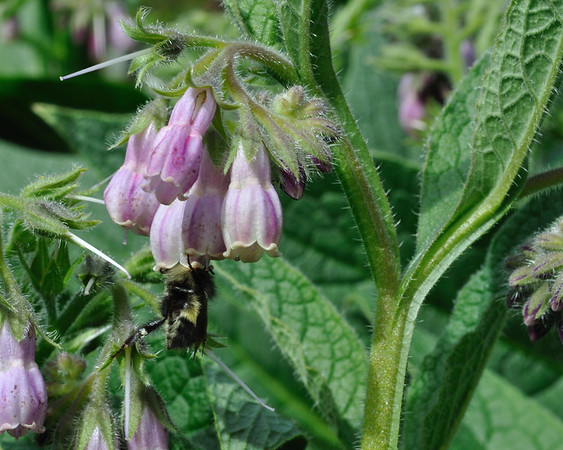
This perennial has slimy roots and leaves that are used externally for bruises, sprains, and dry, irritated skin. Russian comfrey has deep roots to draw nutrients to the surface, and makes great compost and green mulch. The variety we carry is a Russian hybrid type similar to Bocking #14 that does not seem to have fertile seeds.
Although there are many references to the dangerous prrolizidine alkaloids that may cause liver damage found in comfrey and other members of the borage family, many herbalists continue to recommend it for patients with healthy liver function to take internally for short periods of time to speed recovery from injury. The studies in the late 1970’s that caused the uproar about pyrrolizidine alkaloids were performed by injecting lab rats with high doses of comfrey extract, not by feeding them reasonable doses of whole leaves or roots.
For more information, see:
http://www.ncbi.nlm.nih.gov/pubmed/287835
http://www.comfreycentral.com/conclusion.htm
http://www.wisewomantradition.com/healingwise/2008/02/comfrey-leaf-in.html